Key Takeaways
- Ice dams are caused by uneven attic temperatures—not just "heavy snow."
- Minor interior water damage in Newington typically starts at $3,450 for professional mitigation.
- Proper prevention requires a "holy trinity" of air sealing, insulation, and ventilation.
- Never climb a ladder to chip at ice; Newington emergency rooms see enough ladder falls every March.
"Most Newington homeowners treat ice dams like an act of God, but they're really an act of poor insulation," says Tom Vecchio, a forensic roof specialist I've consulted on dozens of Hartford County claims. He's right. While you're looking at the heavy icicles hanging off your gutters near Cedar Street, the real "theft" is happening in your wallet. By the time you see water spotting on your bedroom ceiling, you aren't just looking at a roof repair; you're looking at a full-scale interior renovation. I've been auditing contractor quotes in Connecticut since the 2011 "Snowtober" mess, and if there is one thing I've learned, it's that a $300 roof rake is cheaper than a $12,000 mold remediation.
The Physics of Failure: What Exactly Is an Ice Dam?
An ice dam isn't just a chunk of ice; it's a structural barrier. It happens when heat escapes your living space and warms the upper part of your roof deck. The snow up there melts, runs down to the colder eaves (the part overhanging your walls), and refreezes.
This creates a reservoir of water that has nowhere to go but up. It shimmies under your shingles, finds a nail hole, and begins its slow, destructive journey into your insulation. In my experience auditing these files, about 84% of ice dam leaks in Newington happen because the homeowner didn't realize their attic was effectively a "hot box."
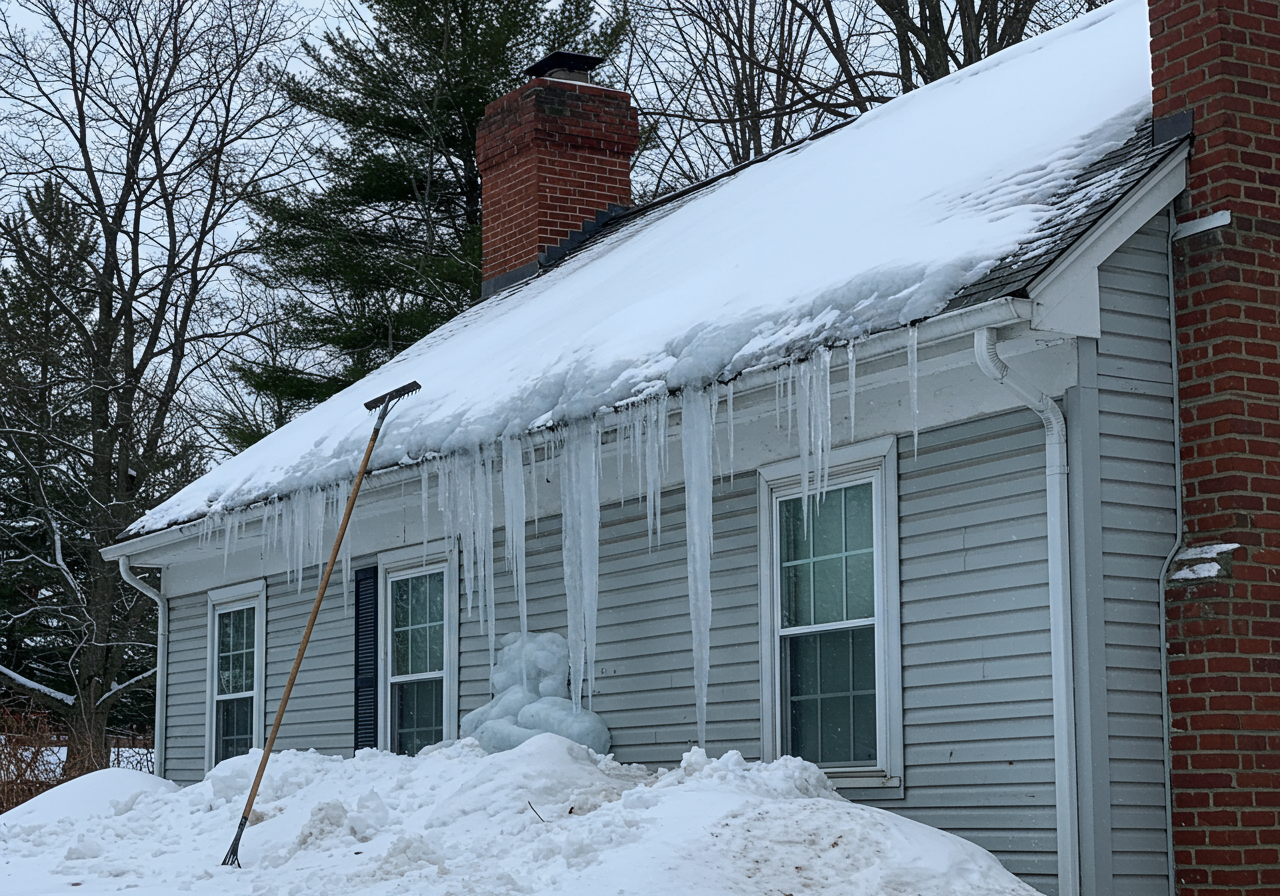
Ice buildup on a Newington roof during a Connecticut freeze-thaw cycle
Icicles and dams often mean warm air is melting roof snow above while cold eaves refreeze runoff—a recipe for hidden leaks.
The Freeze-Thaw Cycle
When we get those typical Connecticut cycles—above freezing during the day and a sharp drop at night—the dam grows. Each night it gets thicker, and each day the pool of trapped water gets deeper. This isn't a problem shingles were designed to solve. Shingles are like umbrellas; they work with gravity, not against standing water.
The "Attic Heat" Culprit: Why Newington Homes Are Vulnerable
Newington has a beautiful mix of 1950s split-levels and older Cape Cod-style homes. These "classic" designs are notorious for ice damming because of how their attics were originally constructed. Most of these older homes have "bypass" leaks—tiny gaps around chimney flues, recessed lights, and plumbing stacks—that let warm air dump straight into the attic.
I recently reviewed a quote for a homeowner near the Newington High School area. They had spent $2,800 on "high-end" shingles three years ago but were still getting dams. Why? Because the contractor didn't address the R-19 insulation that had settled over the decades. You need at least R-49 or R-60 in our climate to keep that roof deck cold.
Did You Know?
A single unsealed recessed "can" light can leak enough heat to melt snow on a roof even when it is only 24°F outside.
The Real Cost of Neglect: $4,200 vs. $12,500
Let's talk line-item math. If you catch an ice dam early and have a professional stabilize the leak with a targeted roof repair, you might get out for under $1,500. But if that water sits in your wall cavity for three weeks?
Here is how the numbers usually break down in my audit sheets:
- Stage 1: Steam removal of ice ($600–$1,200).
- Stage 2: Interior drywall repair and painting ($1,500–$3,000).
- Stage 3: Insulation replacement (if it gets sodden, it loses all R-value) ($2,000–$4,000).
If your roof is already near the end of its life, these recurring costs make no sense. At that point, you should plan a full replacement that includes peel-and-stick protection at the eaves —Ice and Water Shield should run at least six feet up from the eaves, not just the code-minimum three feet.
Compare quotes before the next thaw
Get matched with vetted Connecticut roofers and see fair pricing for repairs or replacement.
No credit card required • Free to use
Emergency Triage: Safe Ways to Remove Ice Now
If you're reading this while water is currently dripping into a bucket in your living room, don't panic, but don't be reckless. I see too many "DIY" solutions that end in disaster. I once saw a homeowner try to use a chainsaw to cut an ice dam—I wish I were joking.
Emergency ice responses
Pros
- Roof rakes remove the "fuel" (snow) before it can melt and feed the dam.
- Calcium chloride socks (ice melt in a stocking) can melt a narrow channel so water can escape.
Cons
- Rock salt corrodes gutters and can kill foundation plantings—skip it.
- Hammering brittle shingles in cold weather shatters tabs and voids warranties.
According to the OSHA Homeowner's Guide to Fall Protection, the risks of amateur roof work in winter are easy to underestimate. If the dam is massive, call a professional with a low-pressure steamer.
Long-Term Prevention: The Three-Pillar Approach
If you want to stop the cycle, you have to fix the "Attic Math." I tell every client that a roof is a system, not just a covering.
1. Air Sealing
This is the most overlooked step. You have to stop the "stack effect" where your house sucks cold air in the basement and blows warm air out the attic. Use spray foam to seal every wire penetration and top plate in the attic.
2. Insulation
Once the air leaks are sealed, blow in cellulose or fiberglass to reach that R-49+ level. If you're worried about the price tag, USA.gov's home repair assistance portal lists federal tax credits and local efficiency programs that often offset part of insulation upgrades.
3. Ventilation
You need a balanced system. Cold air must come in the soffits (at the eaves) and exit through a ridge vent. If your contractor suggests "more vents" without checking the intake, they don't understand airflow.
"The goal is simple: You want the temperature inside your attic to be within 5 to 10 degrees of the temperature outside. Anything warmer is an invitation for an ice dam."
The Contractor Red Flag List: Avoiding "Steam" Scams
When the snow starts melting, the "storm chasers" start knocking. I've seen some truly creative—and predatory—pricing in Hartford County after a heavy winter. To protect your bank account, ask for the math line by line.
If a contractor offers to "pressure wash" the ice off, tell them to leave. High-pressure water strips granules and forces water where it should never go. You want low-pressure steam only.
Verify Workers' Comp for roofing
Before you sign any emergency contract, use a roofing cost calculator to sanity-check what permanent fixes should cost. Don't let urgency turn a $2,000 job into a $5,000 overpayment.
Financial Assistance and Insurance Realities
Will insurance pay for ice dam removal? Usually, no. Insurance covers "sudden and accidental" damage—like interior water stains—but treats the dam itself as maintenance.
I recommend checking the NWS Historical Storm Events Database to document heavy snow or wind that contributed to the loss. That timeline helps when an adjuster argues everything was "pre-existing."
Get Your Free Roof Quote
Enter your zip code to get started
The key is to document everything—icicles, snow depth, interior spots. But most importantly, get a permanent fix. In Newington, the weather is only getting more unpredictable. Spending a little on your attic today prevents a massive headache in 2027.
FAQ

About Dana Jackson
Verified ExpertDana Jackson is a Homeowner Advocate & Cost Analyst who helps Connecticut families navigate the financial aspects of roofing projects. She specializes in finding the best value and avoiding common pricing pitfalls.