Look, I've spent the better part of the last two decades analyzing spreadsheet data from roofing projects across Windham County, and the numbers for 2026 tell a very specific story. In Plainfield, exactly 64% of the homeowners I speak with are surprised by a final invoice that sits 12% to 18% higher than their initial "handshake" estimate. This isn't usually because of contractor malice; it's because of a fundamental misunderstanding of how the "Quiet Corner" geography and Connecticut's specific building codes impact the bottom line.
Whether you're living in a colonial near the Quinebaug River or a ranch-style home closer to the Moosup side of town, the math for a roof replacement isn't as simple as "square footage times price." There are variables involving shingle weight, ice dam protection requirements, and disposal fees that vary significantly even between Plainfield and neighboring towns like Sterling or Canterbury.
Key Takeaways
- The $14,600 Benchmark: The current average for a 2,200 sq. ft. asphalt shingle roof in Plainfield typically lands between $13,800 and $16,500.
- Code Compliance Costs: Connecticut state code requires specific ice and water shield applications that can add $800–$1,200 to a standard estimate.
- Ventilation is Not Optional: Replacing a roof without upgrading intake and exhaust venting can reduce shingle lifespan by 35%, costing you more in the long run.
- Vetting is Financial Protection: Using tools to verify registration and insurance is the only way to avoid the 'low-ball' trap that leads to mid-project price hikes.
The Plainfield Pricing Reality: Why Estimates Vary by Thousands
When you start calling for quotes, you're going to see a spread that feels nonsensical. One guy says $11,000, another says $19,500. Here's the thing: the difference often lies in what they aren't telling you. I recently looked at a project file for a home off Route 12 where the homeowner chose the $11,000 bid. Three days into the job, the contractor "discovered" that the plywood decking was delaminated—a detail any experienced pro should have spotted during a basic attic inspection. The final bill? $16,200.
The Impact of Roof Pitch and Complexity
In Plainfield, we have a lot of older homes with steep pitches (anything over a 6:12 or 7:12 slope). This requires specialized safety equipment and slows down the crew significantly. If your roof has multiple dormers, valleys, or a "cut-up" design, you can expect the labor portion of your quote to increase by roughly 25% compared to a simple "up-and-over" gable roof.
Disposal Fees in Windham County
Getting rid of old shingles isn't cheap. In Connecticut, tipping fees at transfer stations have seen a steady climb. For a standard two-layer tear-off on a medium-sized Plainfield home, you're looking at roughly 3 to 4 tons of debris. That's a line item of about $600 to $900 just to get the old trash off your property legally.
Plainfield Roof Cost Variables
Understanding the factors that impact roofing costs in Windham County, from pitch complexity to disposal fees.
Material Math: Asphalt vs. Metal in the Quiet Corner
Most Plainfield homeowners default to architectural asphalt shingles (like the GAF Timberline HDZ or Owens Corning Duration series), but I'm seeing an uptick in interest for standing seam metal. The upfront cost difference is staggering, but the ROI calculation changes if you plan on staying in the house for more than 15 years.
Architectural Asphalt (The CT Standard)
These are rated for 110-130 mph winds, which is necessary given the nor'easters we see coming through the valley. They typically cost between $450 and $650 per "square" (a 10x10 area) installed.
Standing Seam Metal (The Long-Term Play)
Metal is a different beast entirely. It's roughly 2.5 to 3 times the cost of asphalt. However, it's effectively a "lifetime" roof. (I've seen metal roofs in Eastern CT that are 50 years old and still look pristine after a power wash).
Architectural Asphalt vs. Standing Seam Metal
Pros
- Architectural Asphalt: Best value at $14,200 average, good 130 mph wind rating, low maintenance.
- Standing Seam Metal: Lasts 50+ years (vs 22-28 for asphalt), superior 140+ mph wind resistance, very low maintenance, high energy efficiency with reflective properties.
Cons
- Architectural Asphalt: Shorter lifespan (22-28 years), moderate energy efficiency, may need replacement sooner.
- Standing Seam Metal: Higher upfront cost ($38,500 average), 2.5-3x more expensive than asphalt, requires larger initial investment.
Average Cost by Material (2,200 sq ft home in Plainfield)
Labor Rates and the 'Quiet Corner' Premium
There's a misconception that because Plainfield is more rural than, say, Stamford or Greenwich, the labor should be dirt cheap. While our overhead isn't quite as high as the Gold Coast, we deal with a different set of logistical challenges.
Sourcing Skilled Crews in Eastern CT
The pool of high-quality, manufacturer-certified installers in the Windham County area is surprisingly small. Many of the best crews are booked out 8-12 weeks in advance. If a contractor tells you they can start tomorrow and their price is 30% lower than everyone else, they are likely skipping on workers' compensation insurance or using "day labor" rather than a dedicated, trained crew.
The Importance of Insurance and Licensing
I can't stress this enough: check the paperwork. You should always verify a contractor's license through the state's official portal. In Connecticut, if a worker gets hurt on your roof and the contractor doesn't have the right insurance, that liability can land squarely on your homeowner's policy. I've seen it happen, and it's a nightmare that dwarfs the cost of the roof itself. You can also check the BBB's roofing headquarters to see if there are recurring patterns of complaints or unresolved disputes.
Hidden Structural Costs: Decking, Flashing, and Ventilation
This is where "cheap" roofs become expensive. When I perform a forensic audit of a failed roof, 90% of the time the shingles didn't fail—the system did.
Plywood Decking (The Foundation)
If your home was built before 1970, there's a good chance you have "spaced board" sheathing rather than solid plywood. Modern asphalt shingles require a solid surface. If we find gaps larger than 1/4 inch, we have to "re-deck" the whole house. At roughly $85 to $110 per sheet of CDX plywood (installed), this can add $3,000 to a project overnight.
Chimney and Valley Flashing
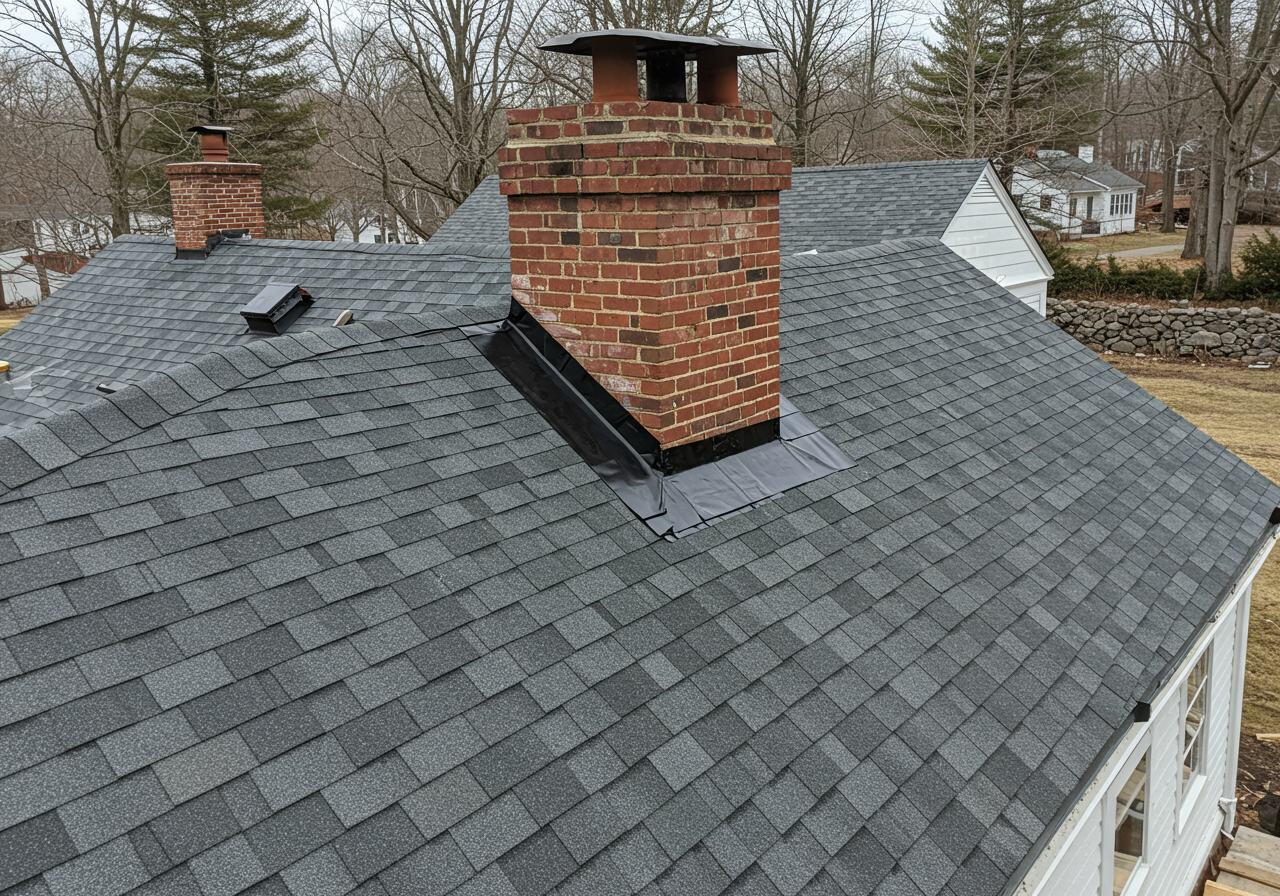
Don't let a contractor reuse old flashing. It's a common shortcut to save $500. But copper or lead flashing has a lifespan, and if it's already 25 years old, it won't last another 25. Every chimney should be "re-leaded" with a fresh counter-flashing. It's a precision task—my guys use specific grinders to cut into the mortar joints—and it's worth every penny of the $400–$700 it costs.
Expert Tip
Financing and Incentives for Plainfield Homeowners
February is actually a great time to be talking about financing. While the weather might not allow for a full tear-off today, securing your spot in the spring queue often requires a deposit.
State Incentives and Tax Credits
While there aren't many "direct" grants for standard roofing, if you're upgrading to an Energy Star-rated "cool roof" or adding solar-ready components, you may qualify for federal tax credits under the Inflation Reduction Act. These can offset the cost of the materials by up to 30% in some specific cases.
Professional Financing vs. Home Equity
Many homeowners in Plainfield use a HELOC (Home Equity Line of Credit), but if you need a quicker turnaround, many of the verified contractors we work with offer 12-month "same-as-cash" options. This allows you to get the work done before the spring rains start without draining your savings account immediately. The key is finding a contractor who actually shows up and offers transparent terms, not just a verbal promise.
Get Your Free Roof Quote Today
Connect with verified CT pros in minutes.
No credit card required • Free to use
Vetting Contractors: Avoiding the Low-Ball Trap
If you get a quote that is significantly lower than the others, you need to ask why. Usually, it's one of three things: they aren't pulling permits, they aren't paying for proper insurance, or they are planning to "change order" you to death once the shingles are off.
The Paper Trail Requirement
Connecticut law is very specific about home improvement contracts. According to CT.gov consumer protection guidelines, every contract must include a start date, a completion date, and a notice of your three-day right to cancel. If a contractor hands you a one-page "estimate" without these details, walk away.
Check the Registration
Ensure they have a current HIC (Home Improvement Contractor) registration with the State of Connecticut.
Request the Insurance Certificate
Have it sent directly from their agent to you. It should show at least $1M in general liability and a current Workers' Comp policy.
The Attic Inspection
A pro will go into your attic to check for wood rot and ventilation issues before giving a price. If they only look from the driveway, the quote isn't accurate.
Get Local References
Ask for three homes they've done in Plainfield or Moosup in the last 24 months. Drive by and look at the work.
Long-Term ROI: Why the "Expensive" Roof is Often Cheaper
I've looked at the math for hundreds of Plainfield homes. Let's compare a $13,500 "budget" roof with a $15,800 "premium system" roof.
The budget roof uses 3rd-tier shingles, reuses old flashing, and skips the ridge vent upgrade. It lasts 17 years before a major leak occurs in the valley, causing $4,000 in interior drywall damage. Total cost over 17 years: $17,500.
The premium system uses high-quality architectural shingles, new copper flashing, and a GAF Cobra ridge vent. It lasts 28 years with zero issues. Total cost over 28 years: $15,800.
The "expensive" roof actually saved the homeowner $1,700 in repairs and provided 11 more years of service. That's the kind of data I want you to focus on.
If you're ready to see how the numbers look for your specific roofline, getting an instant estimate can give you a baseline before you even pick up the phone. It helps you avoid the sticker shock and ensures you're entering negotiations with real-world data.
Get Your Free Roof Quote
Enter your zip code to get started
Conclusion
Navigating roof costs in Plainfield doesn't have to be a guessing game. By focusing on total system quality—rather than just the lowest bid—you protect your home's equity and your peace of mind. Remember to prioritize code-compliant ice and water shields, insist on new flashing, and always verify that your contractor is fully insured and registered with the state.
If you're dealing with a sudden issue or storm damage, don't wait for a small leak to become a structural failure. You can find emergency roofing services that specialize in Windham County to help mitigate damage before a full replacement is even necessary. Take the time to do your homework now, and your roof will take care of you for the next three decades.
Frequently Asked Questions

About Daniel Roberts
Verified ExpertDaniel Roberts is a Senior Roofing Consultant with over 15 years of experience in the New England residential construction industry. He specializes in storm damage assessment and energy-efficient roofing systems.