
Key Takeaways
- Grade 1 heartwood is non-negotiable for Milford's coastal climate—lower grades rot in 12-15 years.
- Cedar Breather underlayment adds $1.15/sq ft but extends roof life from 15 to 40+ years.
- The silvering patina that develops in 14-22 months is authentic and desirable, not a defect.
- Stainless steel fasteners are mandatory near the Sound—galvanized nails fail within 2 years.
After the nor'easter that rattled our windows last week, I took a drive down toward the Milford Green to see how the older colonials fared. While most of the neighborhood was busy picking up stray shingles from their lawns, one house on a corner lot caught my eye—its cedar roof looked even better after the rain, a deep, rich amber that stood out against the gray February sky. It reminded me that choosing a roof isn't just about keeping the attic dry; it's about how your home "meets the sky" and fits into the character of our coastal community.
If you've been weighing the leap from asphalt to wood, you're likely staring at a price tag that feels a bit daunting. But here is the thing: a cedar roof isn't just a material choice; it's a long-term design strategy. When done right, it can be the most striking feature of your property. When done wrong, it's a $22,000 headache. Let's talk about how to make sure yours falls into the first category.
1. The Coastal Aesthetic and "The Silvering"
Living in Milford, especially if you're anywhere near the water, means you have a unique relationship with the elements. Cedar is a living material. Unlike a static gray shingle, cedar reacts to our salt-saturated air. Within about 14 to 22 months, those golden-brown shakes will transition into a classic driftwood silver.
I've seen homeowners panic when they see the first signs of graying, but on a New England colonial or a shingle-style home near Bayview, that patina is exactly what you want. It signals authenticity. However, you have to choose a wood that can handle this transition. I always recommend Western Red Cedar for our area because its natural oils are basically a built-in defense mechanism against the damp February mists we get coming off the Sound.
2. Choosing Your Cut: Shakes vs. Shingles
One of the biggest points of confusion I hear from neighbors is the difference between a "shingle" and a "shake." It's not just semantics; it changes the entire "visual weight" of your house. Cedar shingles are sawn on both sides, giving them a uniform, tailored look that feels very crisp and "Milford Green."
Shakes, on the other hand, are typically hand-split. They're thicker, more rugged, and have a heavy texture that creates deep shadow lines. If your home has a lot of architectural detail, a taper-sawn shake can provide a beautiful middle ground. I remember helping a couple over on Pond Point Avenue choose between the two; they went with a heavy shake, and it transformed their 1980s build into something that looked like it had been there for a century.
Cedar Shingle vs. Hand-Split Shake
| Feature | Shingle | Shake |
|---|---|---|
| Visual Style | Tailored, Smooth | Rugged, Textured |
| Thickness | Uniform | Variable/Heavy |
| Cost (Avg) | $12,400 - $18,000 | $16,500 - $24,000 |
| Shadow Lines | Subtle | Deep/Dramatic |
3. The "Grade 1" Non-Negotiable
If there is one place to be a total snob about your home improvement, it's wood grading. You will see "Blue Label" or Grade 1 shingles—these are 100% heartwood, 100% edge grain, and 100% clear. This means no knots and no sapwood.
Why does this matter in Milford? Sapwood is essentially "tree candy" for the mold and fungi that thrive in our humid summers. If your contractor tries to save you $2,400 by using a lower grade with flat grain, politely show them the door. Flat grain curls and "checks" (splits) much faster when exposed to the freeze-thaw cycles we see every February. You want that edge grain to ensure the wood expands and contracts evenly. I always suggest that homeowners see what other CT homeowners experienced with different materials before committing to a specific wood grade.
4. Ventilation: The Secret to a 40-Year Roof
The biggest enemy of a cedar roof isn't the rain; it's the inability to dry out. In the old days, cedar was nailed to "spaced sheathing" (slats of wood with gaps between them), which allowed the wood to breathe from both sides. Most modern Milford homes have solid plywood decks, which can trap moisture and rot the wood from the inside out in as little as 12 years.
To fix this, we use a "cedar breather"—a nylon matrix that creates a small air gap between the wood and the deck. It's an extra cost, usually around $1.15 per square foot, but it's the difference between a roof that lasts through 2050 and one that fails by 2038. According to FEMA's hurricane mitigation guide, proper attachment and ventilation are also key components in ensuring your roof stays put during high-wind events on the coast.
Ask your contractor specifically about 'Cedar Breather' or 'Matrix' underlayments.
5. Fire Retardants and Local Codes
While we don't have the same wildfire risks as the West Coast, fire safety is still a factor in New Haven County building codes. Most cedar used today is pressure-treated with fire retardants (Class A, B, or C).
I've had homeowners worry that these treatments will leach out and kill their foundation plantings or change the color of the wood. Modern treatments are much more stable now than they were 15 years ago. Not only do they provide peace of mind, but they can also sometimes help with your homeowner's insurance premiums. It's a design choice that also happens to be a safety choice.
The Energy Efficiency Angle
6. The 30% Premium: Is It Worth It?
Let's be honest about the numbers. A cedar roof in Milford is going to cost you roughly 2.5 to 3 times what a standard architectural shingle would. For a typical 2,500-square-foot roof, you might be looking at $24,800 versus $9,200.
But you have to look at the "Value Over Time." Cedar has a much higher ROI (Return on Investment) when you go to sell. If you're in a neighborhood like Morningside or Woodmont, an asphalt roof can actually look out of place on a high-end home. When you upgrade to a new roof system that matches the architectural pedigree of the house, you aren't just spending money; you're protecting equity.
Cedar vs. Asphalt for Milford Homes
Pros
- Natural insulation properties
- Life span up to 40-50 years
- Superior wind resistance
- Unmatched curb appeal
Cons
- Higher initial investment
- Requires periodic cleaning
- Longer installation time
7. Finding a "Wood-First" Contractor
Installing cedar is a disappearing art. It requires different nailing patterns, different flashing techniques (copper is the standard for cedar), and a lot more patience than asphalt. I always tell my friends to verify their contractor's license and specifically ask to see a wood project they did at least five years ago.
You want to see how that roof has aged. Are the courses still straight? Are there any curled or "cupped" shingles? A contractor who primarily does asphalt might try to "wing it" on a cedar job, and that is where the $10,000 mistakes happen. I once saw a beautiful colonial where the roofer used galvanized nails instead of stainless steel; within two years, every single nail head had left a black streak down the wood.
"In our coastal environment, stainless steel fasteners are the only way to go. If you use galvanized nails on cedar near the Sound, the salt air will eat them for breakfast, and your shingles will be in the yard before the next big storm."
8. Maintenance: The "Set It and Forget It" Myth
The biggest mistake you can make with a cedar roof is ignoring it. Every 5 to 7 years, it needs a professional soft-wash (no high-pressure power washing!) to remove moss and lichen. In a wooded town like Milford, those oak and maple leaves can trap moisture on the roof, leading to rot.
There are also topical treatments that can UV-stabilize the wood or add extra water repellency. While cedar is naturally rot-resistant, these treatments are like putting a good coat of wax on a luxury car. If you're curious about the financial side of these upgrades, you can check the IRS instructions for residential energy credits to see if any of your holistic home improvements (like solar vents or insulation added during the re-roof) might qualify for a tax break.
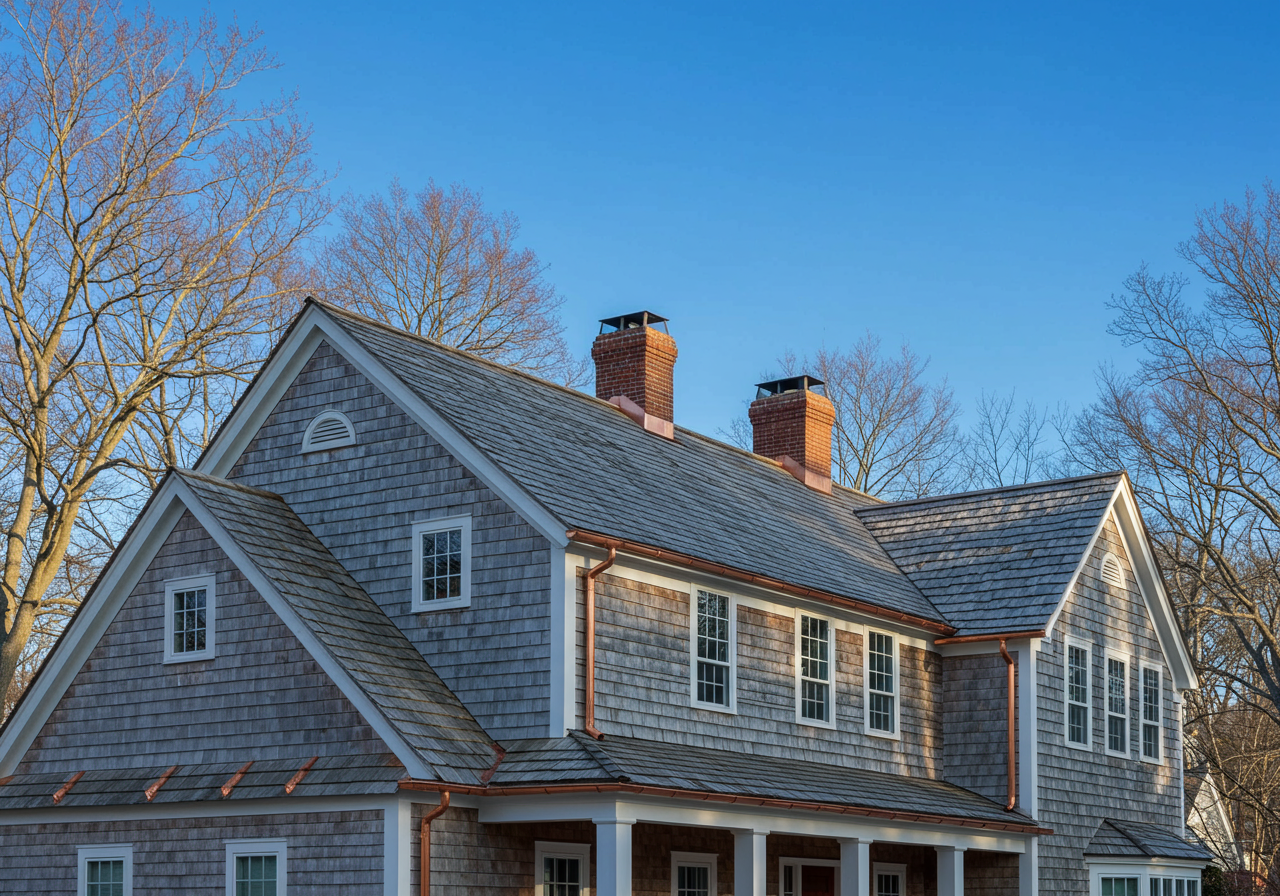
Weathered Silver Cedar Shakes
A close-up of weathered silver cedar shakes on a Milford colonial home with copper flashing
Deciding on a cedar roof is a bit like choosing a vintage car—it takes a little more love, but the payoff is something that truly turns heads. If you're ready to see how the numbers look for your specific roofline, the best first step is getting an accurate baseline.
Get Your Free Roof Quote
Enter your zip code to get started
Conclusion
Investing in cedar shake for your Milford home is one of the few exterior choices that pays dividends in both soul and "sold" signs. By focusing on Grade 1 heartwood, ensuring your contractor uses a breather underlayment, and committing to a simple maintenance schedule, you can ensure your roof remains a neighborhood standout for the next four decades. Don't let the initial cost scare you away from a material that was literally grown for this climate.