
Key Takeaways
- Mansfield's freeze-thaw cycles create perfect conditions for tree limbs to fall, causing hidden structural damage beyond visible shingles.
- Ground-level visual inspection with binoculars can reveal displaced gutters, ridge line dips, and granule loss indicating high-velocity impact.
- Attic inspection is critical—hairline splintering in rafters and damp insulation signal structural compromise that requires immediate attention.
- Documentation before tree removal is essential for insurance claims, as Tolland County adjusters are detail-oriented and require proof of damage mechanics.
The recent heavy snow that blanketed the areas around Mansfield Hollow and Horsebarn Hill wasn't just a headache for the plows; it was a stress test for our local canopy. I spent yesterday afternoon walking a property near Route 195 where a massive white oak limb had decided to take a nap right across a homeowner's colonial-style roof. From the driveway, it looked like a simple "shingle scratch," but my field notes from similar Tolland County incidents tell a different story. In Connecticut, our February weather cycles—the freeze, the thaw, the heavy wet stick—create the perfect conditions for "widow-makers" to finally give way. When a hundred pounds of hardwood drops from twenty feet, it doesn't just hit the shingles; it sends a shockwave through the entire frame of your house.
1. The Critical Exterior Visual Scan
Before you even think about climbing a ladder, you need to conduct a "ground-level triage." I always tell Mansfield residents to grab a pair of binoculars and walk the entire perimeter of the home. You aren't just looking for where the branch is sitting; you're looking for the "echo" of the impact. Are the gutters pulled away from the fascia? Is there a subtle dip in the ridge line that wasn't there last Thanksgiving? Even if the tree didn't punch a hole through the plywood, the weight can displace the flashing around chimneys or dormers.
If you see granules from the shingles washed down into the downspouts, that's a sign of high-velocity impact that has stripped the protective layer of your roof. For minor punctures or isolated shingle loss, you might only need targeted roof repair services to get through the season. But don't let the lack of a visible hole fool you. I've seen Mansfield homes where the roof looked intact, but the force of the tree limb had actually sheared the nails holding the plywood to the rafters.
2. Checking the "Red Zones" in the Attic
The real truth of a tree strike is found in the dark. You have to get into the attic. I've crawled through enough Mansfield crawlspaces to know that what looks fine from the street often looks like a splintered mess from the inside. Take a high-powered flashlight and look specifically at the rafters directly beneath the impact site. You're looking for "hairline splintering"—cracks in the wood that indicate the structural member has reached its load limit.
According to FEMA's structural protection guidelines, even a small deflection in a roof support can lead to a catastrophic failure under the next heavy snow load. If you see light peeking through where it shouldn't be, or if the insulation is suddenly damp, you have a breach.
Damage Severity Assessment
| Feature | Sign of Damage | Likely Impact | Professional Urgent? |
|---|---|---|---|
| Displaced Shingles | |||
| Split Rafters | |||
| Cracked Flashing |
3. Managing the Moisture and Insulation Crisis
In February, moisture is a stealth killer. When a tree damages your roof, it usually damages your attic's climate seal as well. If that limb compressed your insulation, it's no longer doing its job. I've seen R-values drop by half just because a branch squashed the fiberglass batts or blew out the cellulose. This creates "hot spots" on your roof that lead to ice dams—the last thing you want after a tree strike.
While you're up there, check the Department of Energy's insulation standards to see if your compressed materials still meet the Connecticut energy code. If the tree impact has compromised your attic's ventilation, you're looking at a ticking time bomb for mold. I remember a case near Mirror Lake where a small puncture went unnoticed for three weeks; by the time the March winds hit, the entire north-facing attic slope was covered in black spots because the moisture couldn't escape.
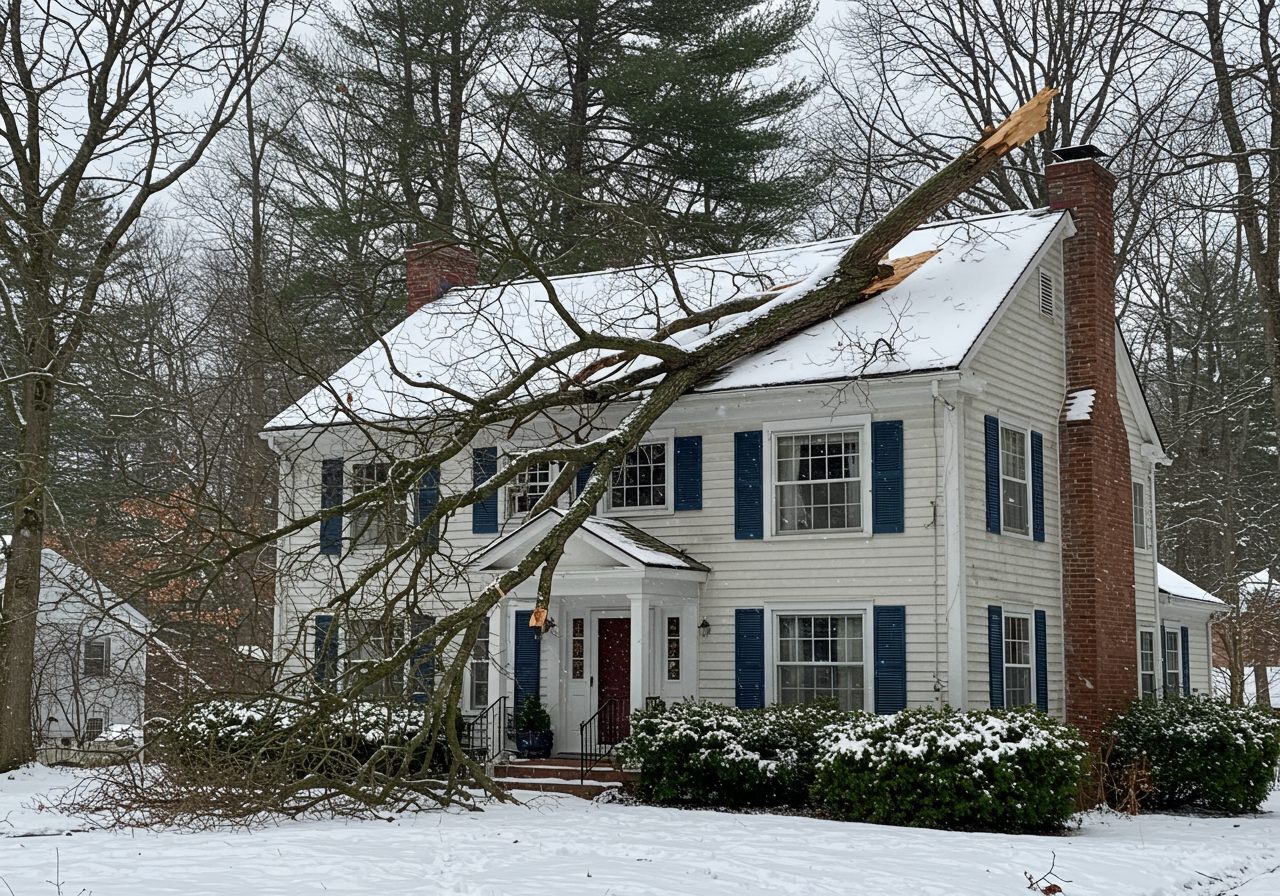
Tree damage assessment on a Mansfield roof
A fallen tree limb can cause hidden structural damage that requires professional inspection beyond what's visible from the ground.
4. Documentation and the Insurance Dance
The biggest mistake Mansfield homeowners make is moving the tree too fast. I get it—you want that eyesore off your house. But your insurance adjuster needs to see the "mechanics of the failure." Before the chainsaw starts, take 20 photos from every possible angle. Show the height the branch fell from. Show the state of the wood—was it a healthy limb that snapped under ice, or was it a rotted trunk that should have been removed years ago? This distinction can be the difference between a full payout and a denied claim.
Tolland County adjusters are notoriously detail-oriented. If the damage is extensive, you'll want to estimate the potential financial hit before you even get the insurance quote back. Knowing the ballpark figure for your specific roof size and material type in Mansfield allows you to negotiate from a position of strength. Don't let a "preferred contractor" tell you a patch job is enough if the structural integrity is gone.
Typical Tree Damage Recovery Costs (Mansfield)
Get Your Free Roof Quote Today
Connect with verified CT pros in minutes.
No credit card required • Free to use
5. Future-Proofing with Resilient Materials
Once the tree is gone and the immediate crisis is over, you have to ask: will the next storm do the same thing? If your property is heavily wooded—which, let's face it, is most of Mansfield—you might want to consider more resilient roofing options. Modern Class 4 impact-rated shingles or standing seam metal roofs can take a "branch beating" far better than the builder-grade asphalt many of us have.
For those considering a more sustainable approach, the EPA's research on cool roofs shows that high-reflectivity materials can also be engineered for high durability. If the damage is widespread enough that a patch won't cut it, exploring full roof replacement services might actually be the most cost-effective move in the long run. It's an opportunity to upgrade your home's "envelope" to something that can handle the increasingly erratic Connecticut winters.
Get Your Free Roof Quote
Enter your zip code to get started
Conclusion
Assessing tree damage in Mansfield isn't just about looking for holes; it's about understanding the hidden stresses a February storm puts on your home's skeleton. From the initial binocular scan to the deep-dive in the attic rafters, every step matters. If you find yourself staring at a maple limb through your skylight, remember to prioritize documentation before cleanup. Be proactive with your insurance adjuster and don't settle for a cosmetic fix if there's structural splintering underneath. Stay safe, keep a close eye on your insulation levels, and use this as a chance to build a more resilient Mansfield home.