
Key Takeaways
- Haddam's freeze-thaw cycles and shoreline humidity create a unique corrosive environment that destroys cheap flashing materials.
- One-piece flashing systems are catastrophic shortcuts that fail when houses settle—professional installations use redundant step and counter-flashing.
- Delaying flashing repairs can turn a $485 fix into a $5,800 structural rebuild as water rots roof framing and decking.
- Copper flashing lasts 50+ years in CT, while standard aluminum fails in 15-18 years—the upfront cost difference pays for itself.
February in Haddam is a particular kind of stress test for masonry. As I look out toward the Connecticut River today, the cycle is predictable: daytime thawing that sends snowmelt trickling down the chimney stack, followed by a sharp overnight freeze that expands that water into ice. This constant "pump" action is exactly what finds the microscopic gaps in a compromised chimney flashing system. If you've noticed a brown stain appearing on the ceiling near your fireplace during these late-winter thaws, you aren't just looking at a roof problem; you're looking at a failure of geometry and material science.
In my years of documenting Middlesex County roof failures, I've found that the shoreline humidity combined with our inland valley frost creates a unique corrosive environment. It's not just about "waterproofing." It's about managing the expansion and contraction of three different materials—brick, wood framing, and asphalt—all meeting at one high-stress junction. Most of the repair calls I field in the 06438 area code involve flashing that was installed as an afterthought. Here's the reality: if your contractor didn't spend at least two hours specifically on the chimney detail, they didn't do it right.
1. The Anatomy of a Haddam Chimney Leak
To understand why your chimney is leaking, we have to look at the layering. A professional flashing installation is never a single piece of metal. It is a redundant system composed of step flashing (the L-shaped pieces woven into the shingles) and counter-flashing (the metal embedded into the brick mortar). In many of the older homes near Haddam Neck, I see "one-piece" flashing. This is a catastrophic shortcut. When the house settles—and in Connecticut, houses always settle—a one-piece system will pull away from either the roof or the chimney, creating a direct funnel for water.
Look, the physics are simple. Water running down a roof hits the vertical wall of the chimney and wants to go inside. The step flashing should direct that water back out onto the shingles. If that step flashing is rusted—common with the cheap galvanized steel used in the late 90s—the water finds the nail holes. I recently inspected a property off Route 154 where the homeowner thought they needed a whole new roof. In reality, the shingles were fine, but the $12 pieces of aluminum flashing had pinholed from salt-air exposure, leading to a precision roof repair that saved them nearly $14,000 compared to a full replacement.
We also have to talk about the "cricket." If your chimney is wider than 30 inches—which most of the substantial wood-burning fireplaces in Haddam are—the International Residential Code (and Connecticut state building code) requires a small peaked roof structure behind the chimney to divert water. I'd estimate 40% of the leak issues I see in Middlesex County are caused by missing or undersized crickets that allow a "pond" to form behind the masonry during our February slush storms.
2. Choosing Materials for the Middlesex Shoreline
Material choice isn't just an aesthetic decision; it's a financial one based on the chemistry of our region. In Haddam, we deal with a higher-than-average acidity in our rain and a persistent dampness from the river. While standard 0.019-inch aluminum is the "contractor grade" default, it often fails prematurely due to "galvanic corrosion"—a fancy way of saying the metal reacts poorly with the chemicals in the mortar or the shingles themselves.
I am a staunch advocate for 16-ounce cold-rolled copper for any chimney repair in this area. Yes, the upfront cost is higher—usually about 30% more than aluminum—but it is essentially a lifetime fix. Copper is malleable, meaning it can be bent into the complex "apron" and "corner" shapes required without cracking the factory finish that aluminum relies on for protection. If you are already upgrading to a new roof system in a high-value area like Higganum, skimping on the flashing is like buying a luxury car and putting the cheapest tires possible on it.
Flashing Material Comparison
| Feature | Aluminum | Copper | Lead (Coated) |
|---|---|---|---|
| Expected Life | |||
| Corrosion Resistance | |||
| Malleability | |||
| Local Code Preferred |
Beyond the metal itself, the sealant matters. I see too many "handymen" using standard silicone from a big-box store. In my field kits, I only carry high-performance polyurethanes (like Vulkem or Geocel). These maintain their elasticity at -10°F and won't pull away when the chimney gets hot from a roaring fire in the middle of January.
3. The True Cost of "Wait and See"
I often hear homeowners say, "It only leaks during heavy wind, I'll deal with it in the spring." That is a $5,000 mistake in the making. In our Connecticut climate, that small leak isn't just wetting your drywall; it's feeding a colony of mold and saturating the "rim joist" and "header" of your roof frame. By the time you see a drip on your living room floor, the plywood decking around that chimney has likely reached a 25% moisture content—the "sweet spot" for structural rot.
Cost of Delayed Flashing Repair (Haddam Avg)
When I'm doing an inspection, I use a FLIR thermal imaging camera. Last year, on a home near the Haddam Meadows State Park, the homeowner swore the leak was minor. The thermal scan showed a 4-foot wide plume of moisture behind the siding that had already rotted the structural wall studs. If they had spent $1,200 on a proper flashing job two years prior, they would have avoided the $6,700 structural repair bill they eventually faced.
If you're unsure about the scope of your damage, you can estimate your potential project cost using our data-driven tools, but remember that the longer you wait, the further that number climbs. A chimney leak is a progressive disease for your house.
4. Vetting Your Haddam Contractor
This is where things get tricky in Middlesex County. Because chimney flashing is tedious work, many "storm chasers" or low-bid contractors will try to "caulk and walk." They'll smear a thick bead of roof cement (that black tar stuff) around the base of the chimney and tell you it's fixed. That tar will dry out, crack, and fail in exactly one season.
Before you sign anything, you must verify their credentials. I always tell my neighbors to check the CT eLicense portal to ensure the company is actually registered as a Home Improvement Contractor (HIC). In Connecticut, it is illegal to perform this work without that registration. Furthermore, the Connecticut Department of Consumer Protection provides specific guidelines on what a roofing contract must include—like a start and end date. If your contractor's "estimate" is a scribbled note on the back of a business card, show them the door.
The 'Reglet' Test
Don't be afraid to ask for local references in Haddam or East Haddam. A reputable pro should be able to point to a chimney they flashed five years ago that is still bone-dry. You can also look at the Better Business Bureau's roofing headquarters to see if there are patterns of complaints regarding "unresolved leaks" for the company you are considering.
5. Maintenance: The 2026 Checklist
Even a perfect flashing job requires a 10-minute check-up once a year. For my clients in Haddam, I recommend doing this in late October, before the first snow. You don't necessarily need to get on a ladder; a good pair of binoculars can tell you a lot from the ground. Look for "lifting" metal or any moss growing at the base of the chimney. Moss is a red flag—it means the area is holding moisture, which is the precursor to flashing failure.
Inspect Chimney Shoulders
Inspect the 'shoulders' of the chimney for cracked mortar (repointing may be needed before flashing).
Clear Cricket Debris
Clear debris (pine needles/leaves) from the 'cricket' area to prevent water damming.
Check for Pinholing
Check for 'pinholing' in aluminum flashing caused by acid rain.
Verify Kick-Out Flashing
Verify that the kick-out flashing is still directing water into the gutter, not behind the siding.
One detail I often see missed is the "kick-out" flashing where the roof meets a vertical wall. In our shoreline-adjacent climate, wind-driven rain can be forced sideways. If that kick-out isn't there, the water gets behind your siding and rots the house from the inside out. I've seen this happen on $1M+ homes in the Haddam hills just as often as on smaller cottages. It's a 5-minute install during a roof job that prevents a 5-figure headache later.
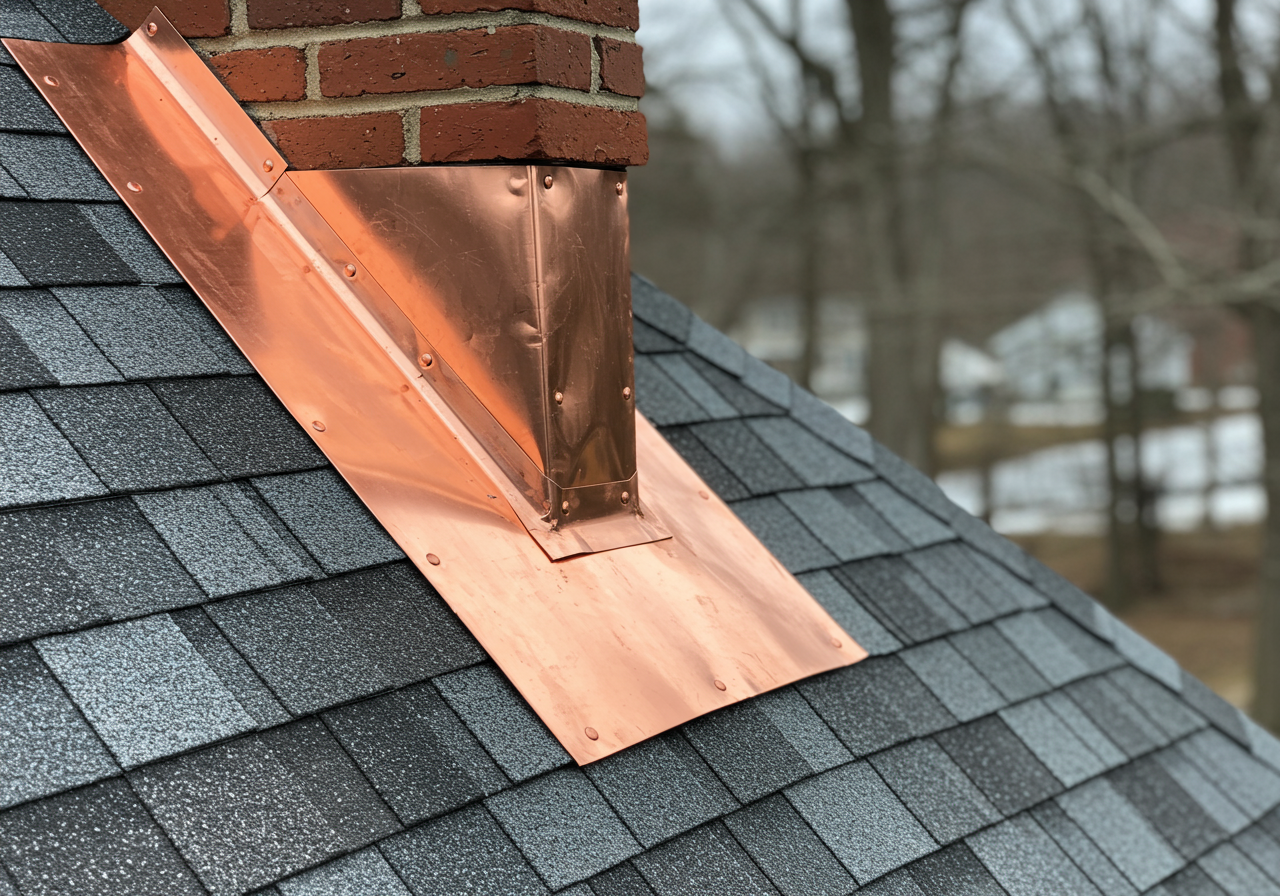
Precision Flashing Detail
A textbook example of copper counter-flashing properly inset into the mortar joints of a Connecticut chimney.
At the end of the day, your roof is a system, and the chimney is its most vulnerable point. By insisting on high-grade materials like 16oz copper and ensuring your contractor follows the "reglet" method for counter-flashing, you are buying peace of mind for the next three decades. It's about doing it once and doing it right.
Get Your Free Roof Quote
Enter your zip code to get started
In my field notes from the last twenty years, the homeowners who are happiest aren't the ones who got the "cheapest" roof; they're the ones who didn't have to think about their roof again for twenty years. If you're smelling a musty odor in your attic or seeing "bubbles" in the paint near your chimney, the time to act is now—before the February freeze-thaw cycle does any more damage to your Haddam home's skeleton.