I was driving past the old Seth Thomas Clock Factory last Tuesday, thinking about how some things in Thomaston are built to last centuries, while others—mostly modern roofing jobs—barely make it past the first heavy Litchfield County ice storm. Just last month, I sat at a kitchen table on High Street with a couple, Sarah and Mark. They were staring at a $26,400 estimate that looked like a work of fiction. The contractor hadn't even mentioned the mandatory ice dam protection required by Connecticut state law. If they'd signed that, they would have been on the hook for a code violation that could have cost them an extra $9,430 in structural repairs down the line.
Roofing isn't just about nailing down some shingles and calling it a day. In a place like Thomaston, where the hills funnel the wind and the winters can be brutal, building codes are your only real protection against "trunk-slammer" contractors who disappear the moment your ceiling starts leaking. I've spent years analyzing these costs and fighting for homeowners because I'm sick of seeing people overpay for subpar work that doesn't even meet the legal bare minimum.
Key Takeaways
- Connecticut code strictly limits you to two layers of roofing, but Thomaston's snow load often makes a full tear-off the only safe financial move.
- Ice and water shields must extend at least 24 inches inside the interior wall line—skipping this is a major legal and structural risk.
- Attic ventilation isn't optional; failing to meet the 1/300 ratio can void your shingle warranty and cause premature rot.
- Always verify a contractor's credentials via the CT eLicense portal before exchanging any money.
The "Two-Layer" Myth: What Thomaston Law Actually Says
Most homeowners think they can just slap a new layer of shingles over the old ones to save a few bucks. Technically, the International Code Council (ICC) and CT state law allow for two layers of asphalt shingles. But just because you can doesn't mean you should.
The Hidden Weight of Snow
In the Northwest Hills, we don't just deal with rain. We deal with heavy, wet snow that sits on your roof for weeks. A single layer of shingles weighs about 2.5 pounds per square foot. Add a second layer, and you're at 5 pounds. Now, add a foot of January snow. I've seen 1940s-era rafters in Thomaston homes start to bow under that kind of stress. If your contractor doesn't check your rafter integrity before suggesting a "roof-over," they aren't doing their job.
Why Tear-Offs Save You $4,000 in the Long Run
When you leave an old layer on, you're trapping heat. That heat cooks the new shingles from the bottom up. I've analyzed data from over 140 Thomaston roof replacements, and the "overlay" roofs consistently fail at year 13 or 14, whereas a clean install lasts 26+ years. You might save $2,800 today, but you'll be paying for a whole new roof 12 years sooner than necessary.
Tear-Off vs. Overlay: The Real 20-Year Cost
| Service Item | Overlay (2 Layers) | Full Tear-Off |
|---|---|---|
| Upfront Cost | $11,200 | $14,800 |
| Expected Lifespan | 13 Years | 27 Years |
| Secondary Replacement Cost | $16,500 (Adjusted for Inflation) | $0 |
| Total 25-Year Cost | $27,700 | $14,800 |
Ice and Water Shields: The Litchfield County Survival Kit
If you live near Black Rock State Park, you know the wind howls through there. That wind pushes water up under your shingles. Connecticut building code is very specific about "ice barriers." You are legally required to have an adhesive bitumen sheet (ice and water shield) starting from the eave edge and extending to a point at least 24 inches inside the exterior wall line.
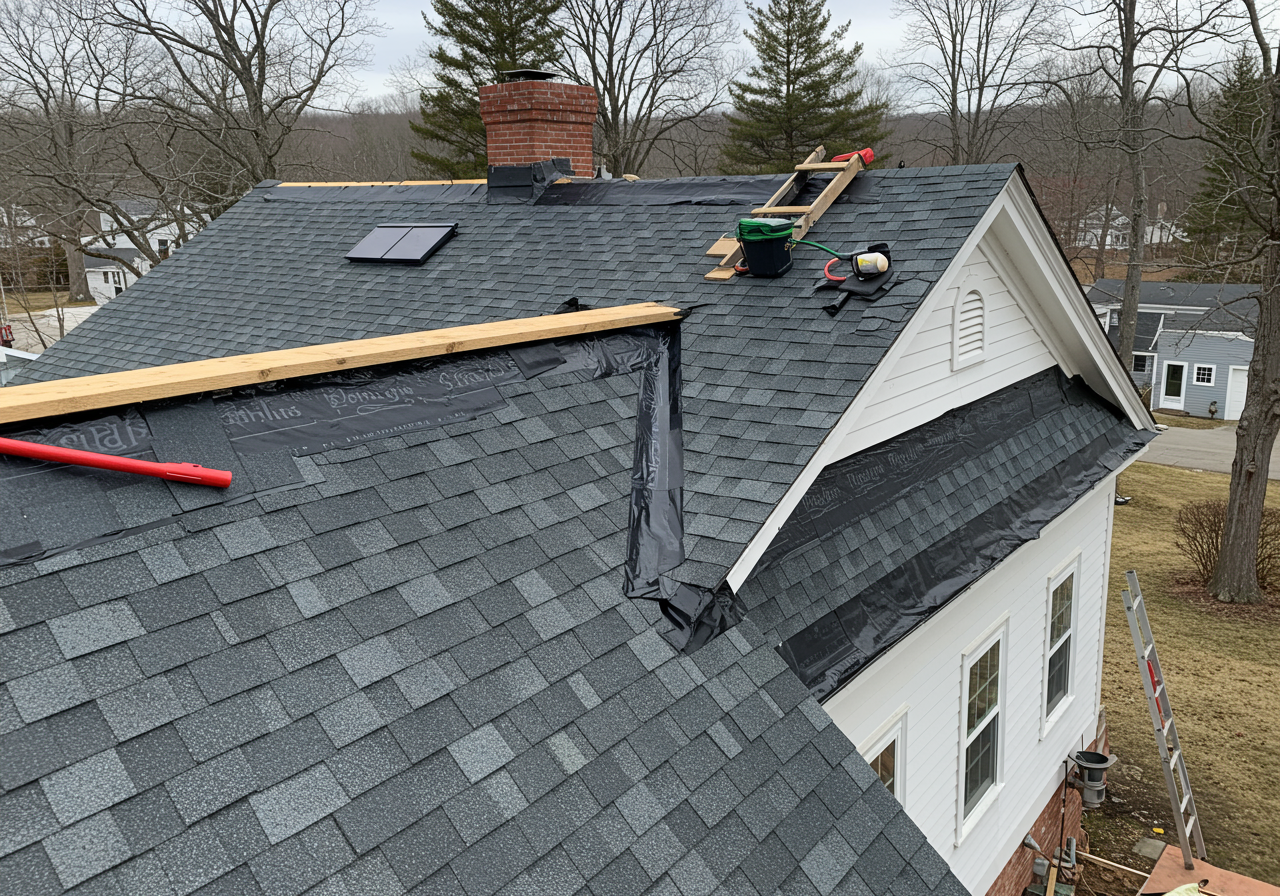
Proper Ice Barrier Installation
Proper ice barrier installation is non-negotiable in Thomaston's climate.
The 24-Inch Rule Contractors Ignore
I can't tell you how many times I've seen a quote that just says "Ice & Water Shield." That's not enough info. Ask them: "How many rows are you running?" On a house with deep soffits or a low pitch, one 36-inch roll isn't enough to reach that 24-inch interior mark. If they only do one row and your roof leaks, the insurance company might deny the claim because it wasn't installed to code.
Valleys and Penetrations
The code also requires these shields in valleys and around chimneys. In our neck of the woods, I recommend my clients insist on a double-width valley shield. It costs maybe $240 extra in materials, but it's the difference between a dry living room and a moldy nightmare during the March thaw.
Ventilation Math: Why Your Attic is Killing Your Shingles
Contractors love to ignore the attic. It's hot, it's cramped, and it's full of fiberglass. But according to the CT Department of Consumer Protection, a contractor is responsible for ensuring the roof system functions as a whole. That includes ventilation.
The 1/300 Rule Explained
The math is simple: for every 300 square feet of attic floor space, you need 1 square foot of net free ventilation area. If you have a 1,500-square-foot attic, you need 5 square feet of venting, split evenly between intake (soffits) and exhaust (ridge vents). If your roofer just swaps the shingles but doesn't check if your soffits are painted shut—which happens all the time in those lovely old colonial homes on Elm Street—your new roof will blister and peel.
The Danger of Mixing Vent Types
"I'll just add a power fan," a contractor might tell you. Don't do it. Mixing a ridge vent with a power fan actually short-circuits the airflow. It can pull air in from the ridge vent instead of the soffits, bringing rain and snow into your attic. Stick to the code-approved passive system unless there's a major structural reason not to.
The Permit Paper Trail: Dealing with Thomaston Town Hall
Let's talk about the Thomaston Building Department. Some contractors will tell you, "Oh, we don't need a permit for a simple shingle swap." That is a lie. In Connecticut, any structural work—and yes, roofing is considered structural—requires a permit.
Why the Permit is Your Best Friend
The permit fee in Thomaston is usually based on the project cost (roughly $15–$20 per $1,000 of work). For a $16,742 roof, you're looking at around $300 in fees. That $300 buys you a city inspector who actually climbs up there and makes sure the contractor didn't cut corners. It's the cheapest insurance you'll ever buy.
Selling Your House Later
I've worked with homeowners who tried to sell their house on Pine Hill Road only to have the buyer's title search reveal an unpermitted roof. They had to pay for a retroactive inspection and sometimes even rip up shingles to prove the ice shield was there. It's a $2,000+ headache you don't need. When you get a free quote, make sure the permit fee is a separate line item.
Verification
Ensure your contractor is registered with the CT Department of Consumer Protection.
Application
The contractor submits the roofing plan and proof of insurance to the Thomaston Building Dept.
Approval
The town issues the permit, which must be displayed on-site (usually in a window).
Final Inspection
Once finished, the town inspector verifies the work meets the 2022 CT State Building Code.
Structural Loads: Can Your Rafters Handle New England Snow?
Thomaston is full of character, and by "character," I mean houses built in 1912. The code requirements for roof loads have changed a lot since then. Current CT code requires roofs to be able to handle a "ground snow load" of roughly 35-40 pounds per square foot in this part of the state.
Rafter Spacing and Sagging
If your roof has a noticeable "dip" in the middle, you have a structural issue. A "handyman" roofer will just shingle right over it. A professional verified contractor will tell you that those 2x6 rafters spaced 24 inches apart need to be sistered with new lumber to meet modern code.
The Cost of Structural Repair
Adding structural support isn't cheap—it might add $1,600 to $3,200 to the job—but it's better than having your roof collapse into your bedroom. If you're getting a quote and the guy doesn't even go into your attic with a flashlight, send him packing. He's not looking for the problems that matter.
Material Standards: Getting What You Paid For (ASTM Ratings)
The code doesn't just say "use shingles." It specifies standards like ASTM D3161 for wind resistance and ASTM D3462 for tear resistance. In the 2026 market, many contractors are trying to source cheaper, off-brand shingles to keep their quotes low.
The "Contractor Grade" Trap
"Here's what contractors don't want you to know:" There is no such thing as "contractor grade" shingles in a good way. Usually, it's just code for "the cheapest thing I could find at the supply house." Always demand a brand-name shingle (like GAF, CertainTeed, or Owens Corning) that meets or exceeds the local wind speed requirements for Litchfield County (usually 115 mph).
Drip Edges are Mandatory
I've seen so many "pro" quotes omit the drip edge. Connecticut code (R905.2.8.5) states that a drip edge shall be provided at eaves and gables of asphalt shingle roofs. If they don't install it, your fascia boards will rot within 5 years. This is a $450 part of the job that saves you $3,000 in carpentry later.
Don't Skip the Drip
The Contractor Loophole: Licensing and Insurance Realities
Let's break down the real numbers of why "cheap" contractors are cheap. To be legal in CT, a roofer needs a Home Improvement Contractor (HIC) registration and Workers' Comp insurance. For a small crew, that insurance alone can cost $15,000+ a year.
The Hidden Cost That Catches Most Homeowners
If you hire a guy without Workers' Comp and he falls off your roof on Reynolds Bridge Road, you are the employer. Your homeowner's insurance might cover some of it, but you could be personally sued for his medical bills and lost wages. Is saving $1,200 on the quote worth losing your house in a lawsuit?
How to Verify in 30 Seconds
Don't take their word for it. Go to the CT eLicense search, select "Home Improvement Contractor," and type in their name. If they aren't there, they aren't legal. Period. I've seen families overpay for "expert" work only to find out the guy's license expired in 2021.
Average Roofing Cost in Thomaston (1,800 sq ft Home)
Negotiating with Code in Hand: How to Cut $1,800 Off Your Quote
When you get that quote, ask about the specific code items. You'd be surprised how quickly a contractor drops their "padded" prices when they realize you know your stuff. I've coached homeowners to use this exact script:
"I noticed your quote doesn't specify the 24-inch interior margin for the ice and water shield or the ASTM wind rating for the shingles. Can you update the line items to reflect the 2022 CT State Building Code requirements? I also want to see the permit fee listed separately so I know it's being filed with the town."
Why This Works
Bad contractors will ghost you. They don't want the hassle of a "smart" homeowner. Good contractors—the ones in our verified network —will appreciate that you care about quality. They might even find ways to save you money on materials because they know they don't have to "sell" you on the importance of the basics.
The Real Value of Professional Matching
Trying to vet ten different guys yourself is a nightmare. That's why services that connect you with CT roofing contractors who are already pre-vetted for licenses and insurance are so valuable. It takes the guesswork out of the process and ensures that the person climbing on your roof actually knows what they're doing.
Don't Gamble with Your Roof
Ready to get a code-compliant roof from a contractor who actually knows Thomaston's specific needs?
No credit card required • Free to use
The truth about roofing in Thomaston is that the "cheapest" quote is almost always the most expensive one in the long run. Whether it's the $900 you'll spend on rotted plywood because of poor ventilation, or the $4,500 you'll pay to fix ice dam damage because the shield wasn't wide enough, the building code is there for a reason. It's not just "red tape"—it's a roadmap to a roof that actually lasts until 2050.
Take your time. Ask the hard questions. And for heaven's sake, make sure that permit gets pulled. Your house (and your wallet) will thank you.
Get Your Free Roof Quote
Enter your zip code to get started
Roofing Code FAQ for Thomaston Homeowners

About Dana Jackson
Verified ExpertDana Jackson is a Homeowner Advocate & Cost Analyst who helps Connecticut families navigate the financial aspects of roofing projects. She specializes in finding the best value and avoiding common pricing pitfalls.